
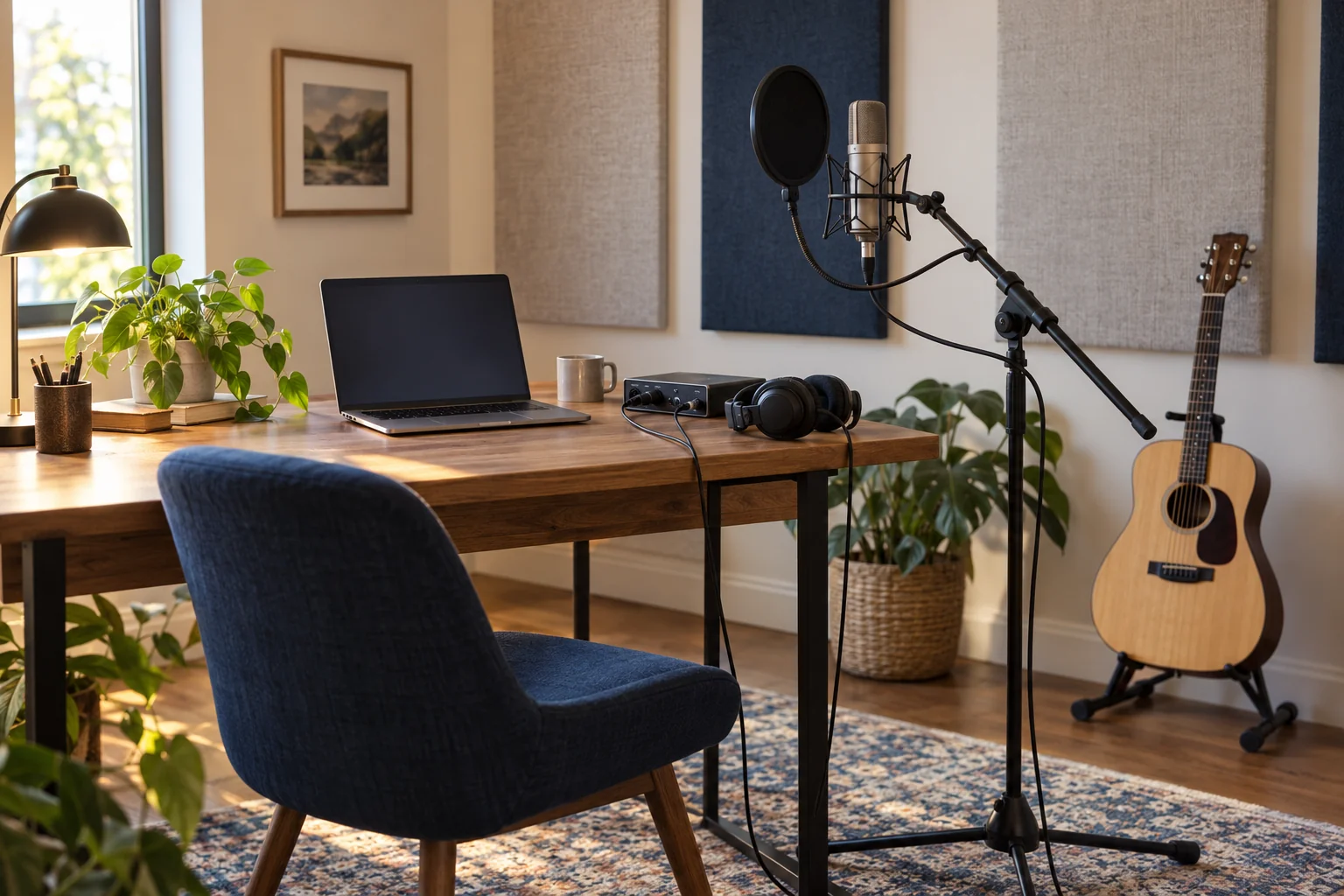
Research-based recommendations. We have not personally tested this equipment. No affiliate links are active.
What do you need for a home recording studio setup?
Start with a compatible computer, a microphone, an audio interface, closed-back headphones, recording software, a stand and the right cables. Add useful room treatment. This kit selects those pieces for one musician recording vocals and instruments one part at a time, then layering the takes into a song.
Both paths can record a vocal or an acoustic guitar immediately. The premium path adds a more flexible microphone, a sophisticated cue mixer and refined listening equipment. The value path keeps the complete signal chain. Computer, instruments, desk, chair and a backup destination are assumed to be available. This is not a full-band or drum-recording rig.
THE EQUIPMENT LIST
One function. Two quality paths.
Choose one option per row, using the quantities shown. A shared choice suits both paths. Prices are US planning references checked October 6, 2026, not live quotations.
| Function and quantity | Premium | Best value |
|---|---|---|
| Condenser microphone · complete package | Austrian Audio OC-S10$2,999.00 | RØDE NT1 Signature Series — Black$141.00 |
| Audio interface · one | Neumann MT 48 U — 700260$1,995.00 | Solid State Logic SSL 2+ MKII$249.99 |
| Closed-back headphones · one pair | Focal Lensys Professional$699.00 | Beyerdynamic DT 700 PRO X$279.99 |
| Microphone stand · one | K&M 210/9 — Black 21090-500-55$116.99 | Same shared choice$116.99 total |
| Microphone XLR cable · one | Hosa Pro HMIC-010 — 10 ft XLR$16.11 | Cable included with NT1No additional cost |
| Acoustic panels · two | GIK Classic Bass Trap Panel — 4 in., 2 × 4 ft2 × $139.00 = $278.00 | Same shared choice$278.00 total |
| Recording software · one license | REAPER 7 — eligible discounted license$60.00 | Same shared choice$60.00 total |
Both microphones include a shockmount and pop filter. The NT1 also includes its XLR cable, counted at no additional cost. Both paths include two acoustic panels and an eligible $60 REAPER license.
Check the computer, room and supplies in the setup checklist. Computer, instruments and backup storage are separate.
Why these choices?
Buy recording quality, not a matching brand. The OC-S10 is a current flagship with useful mounting and pattern options; the NT1 provides a complete, capable fixed-cardioid package. The MT48 adds flexible headphone mixes, while the SSL puts the everyday controls in front of you. Neither path needs an external preamp to get started.
The choices combine current maker documentation with identified-model reviews. Sound On Sound’s microphone and headphone tests date from 2022–2025; its Neumann monitor measurements are from 2023, and Erin’s Kali measurements from 2021. These are dated evidence, not tests we performed or a claim that every competing product has been beaten.
We also considered the Austrian Audio OC818, RME Fireface UCX II and Audient iD14 MKII. They remain credible alternatives. The selected premium interface suits a performer’s cue-mix workflow; the SSL’s current price and physical monitor control make it a stronger value fit here. A familiar DAW or a microphone that suits your voice can be the better personal choice.
Make the room and signal chain work together.
Check the computer first. Confirm current operating-system support for the interface and DAW before buying, including any required driver and USB adapter. A recent compatible Mac or Windows computer is the intended starting point; connector shape alone does not prove compatibility. Test the DAW trial with your system.
Follow one clear path. Microphone → XLR cable → interface mic input → USB → computer. Headphones connect to the interface. Turn monitor levels down before connecting equipment or enabling phantom power, then use 48 V for either selected condenser.
Improve the recording position before adding effects. Move away from noisy fans and reflective corners. Place treatment according to a room plan, including useful absorption behind the singer where appropriate. Compare short dry test takes as you move the microphone. Two panels are a first step, not soundproofing or a complete acoustic design.
WHAT EACH PIECE DOES
The essentials, with their trade-offs.
Austrian Audio OC-S10
A versatile flagship condenser with five pickup patterns, a well-designed shockmount and an included pop filter. Its adjustable mounting makes moving between voice and acoustic guitar less awkward. Sound On Sound’s 2025 hands-on review supports the package’s practical refinement and sound quality.
The trade-offA microphone is a tonal choice, not a universal winner. Audition it on your voice if possible. The reviewer did not directly compare an OC818, so we do not claim a dramatic sound improvement over that less expensive model.
Fit in the kitUse the main XLR output and 48 V phantom power. Start in cardioid, singing toward the logo side through the supplied filter. The second capsule output is an advanced option, not needed for this one-mic setup.
RØDE NT1 Signature Series — Black
A low-noise XLR condenser that leaves money for the rest of the studio. The supplied SM6 shockmount, pop filter and XLR cable make it a complete microphone purchase. A 2024 hands-on review found it capable on both vocals and instruments.
The trade-offIts fixed cardioid pattern offers less flexibility than the Austrian Audio. Placement still matters, and a sensitive condenser will reveal a noisy or reflective room. This Signature model has no USB output or 32-bit-float recording.
Fit in the kitConnect the included 20 ft XLR cable to either chosen interface and enable 48 V. Sing into the front side, not the top. The stand below is separate; the mount and pop filter are already included.
Neumann MT 48 U — 700260
Two microphone preamps, separate instrument inputs and a touchscreen cue mixer make this a strong premium hub for a musician recording alone. Onboard processing lets you hear a comfortable vocal sound while keeping an unprocessed recording, if routed that way.
The trade-offIt requires more setup than the SSL and a separate power supply. Much of its network expansion is unnecessary here. Its extensive controls and engineering justify the choice; they do not guarantee an audible improvement on every recording.
Fit in the kitUse the included power supply in the Power port and the supplied USB cable in Data. Install the current Neumann software for your exact computer. Use a headphone mix for tracking and check the dry recording route before a take.
Solid State Logic SSL 2+ MKII
Two microphone inputs, front instrument sockets and a direct-monitor blend knob make the essentials easy to reach. The second headphone output and MIDI connections leave useful room to grow. Tape Op’s hands-on MKII review supports its practical recording performance.
The trade-offThere is no onboard reverb for the headphone mix. Software effects can introduce audible delay. The front instrument sockets use the same two recording channels as the rear inputs; they do not create four simultaneous inputs.
Fit in the kitConnect with the included USB-C cable or USB-A adapter. Mac operation is class-compliant; Windows needs the SSL driver. Use the direct-monitor blend for a dry vocal and avoid monitoring the same input through the software at the same time.
Focal Lensys Professional
A revealing closed-back headphone suited to tracking and detailed editing. Replaceable cables, a carrying case and a relatively light 306 g body make it practical as well as refined. The included long coiled cable gives a standing singer some movement.
The trade-offSound On Sound’s 2025 review noted a forward midrange and potential pressure from the narrow headband. It is not perfectly neutral or a guaranteed comfort upgrade for every head. Check mixes on other playback systems.
Fit in the kitUse the supplied 6.35 mm adapter in the interface’s headphone output. Keep listening levels modest and check that the backing track does not leak into quiet vocal passages.
Beyerdynamic DT 700 PRO X
A durable closed-back choice with replaceable parts, comfortable velour pads and two detachable cables. The 48-ohm design suits either interface. A published comparative review found it particularly convincing for tracking, which is the first job in this kit.
The trade-offAt about 350 g it is not especially light. The reviewer heard some low-midrange bloom compared with open-back alternatives. Its isolation is useful at a microphone, but do not treat its tonal balance as an absolute mixing reference.
Fit in the kitSelect DT 700 PRO X, not the open DT 900 or a different DT 770 variant. The included adapter connects to either interface, and the longer supplied cable is useful when standing.
K&M 210/9 — Black 21090-500-55
A folding tripod and telescoping boom cover seated guitar and standing vocals without buying two stands. Metal construction and adjustable reach make it a lasting support at either budget.
The trade-offA long horizontal boom becomes less stable with a heavy condenser. Keep the microphone close to the upright, position a leg beneath the boom and check stability before letting go. This is not an overhead rig.
Fit in the kitThis US listing uses a 5/8 in. mounting thread. Check the supplied shockmount’s thread insert and use the correct adapter if needed. Leave cable slack at the mount instead of pulling on it.
Hosa Pro HMIC-010 — 10 ft XLR
A conventional balanced XLR cable with REAN connectors completes the OC-S10 signal path. Reliable connections and an appropriate length matter more here than luxury cable claims.
The trade-offTen feet suits a nearby recording position, not every room. Measure the actual route, including stand height, and buy a longer version if required.
Fit in the kitXLR female goes to the microphone; XLR male goes to the interface’s mic input. Buy one for the premium path. The NT1 already includes its own cable, so the value total adds nothing for this row.
GIK Classic Bass Trap Panel — 4 in., 2 × 4 ft
Two substantial fabric-covered absorbers are a useful first treatment purchase for a vocal recording area. We choose the current 4 in. rectangular version for its depth and coverage, rather than thin decorative foam.
The trade-offTwo panels do not treat a whole room or stop sound reaching neighbors. Placement should follow the room and recording position; deeper bass control or speaker mixing may require substantially more treatment. Older GIK 244 reviews are not tests of this current model.
Fit in the kitBudget two 2 × 4 ft panels, not the cheaper 2 × 2 ft default. Ask GIK for a room plan before ordering. Confirm the mounting system and wall fixings; freestanding feet, ceiling hardware and installation are not included in this basket.
REAPER 7 — eligible discounted license
A fully featured recording workstation for both paths, with multitrack editing, routing and included processing tools. It can grow with a serious recording setup without a subscription. The same audio software serves an expensive microphone as well as a modest one.
The trade-offThere is a learning curve and it is not a large ready-made instrument library. The $60 license is for personal use or other qualifying use, including commercial gross revenue no higher than $20,000 a year; otherwise the commercial license is $225.
Fit in the kitEvaluate the fully functional 60-day trial first, then buy the appropriate license. We budget $60 in each path. Keep a DAW you already know if it meets your needs; an existing suitable license removes this cost.
What is already included—and what is not?
Both microphone packages include a shockmount and pop filter. The RØDE also supplies the XLR cable; the premium basket adds one separately. Both interfaces supply their USB connection cable, and both headphones include the adapter needed for the interface. Check the exact box contents at purchase.
The starting totals include a $25 estimated allowance for suitable panel wall fixings, a stand-thread adapter if required and reusable cable ties. This is not a quoted installation kit. Wall construction, rented accommodation or freestanding supports can change that cost substantially.
Set up a separate backup destination for your session files. Storage hardware or a cloud subscription, instruments, additional room treatment, paid plug-ins and installation labor are outside these totals. The recording setup works without the optional speakers.
Record your first song, one part at a time.
Make a short test session. Select the interface in the DAW and start with 24-bit audio at 44.1 or 48 kHz. Create one mono track for the microphone. Sing or play the loudest passage while setting input gain, leaving clear headroom below clipping. A higher bit-depth label does not make an overloaded input safe.
Hear yourself once. For a straightforward dry take, use the interface’s direct monitoring and disable duplicate software monitoring on that track. If you need a software amp or vocal effect while playing, use software monitoring with a buffer your computer handles reliably, and avoid a doubled direct signal.
Build the arrangement. Record a guide part, then overdub a clean guitar or vocal while listening on headphones. Start a vocal roughly 6–10 in. from the pop-filtered microphone and adjust by listening. For acoustic guitar, try aiming near the neck/body joint rather than directly into the sound hole. Position and performance come before processing.
Save a usable session. Name tracks, keep the best takes and make a separate backup of the project and audio files. Listen quietly on more than one playback system before declaring a mix finished. If your goal is spoken interviews instead, see the Home Podcasting Kit.
PLAN THE SPEND
What does this home music recording setup cost?
Premium path
$6,189.10starter planning estimate · computer excluded
- Microphone, interface and closed-back headphones
- Stand, two panels, cables and recording software
- $25 estimated fixings and small-supplies allowance
Best value path
$1,150.97starter planning estimate · computer excluded
- Microphone, interface and closed-back headphones
- Stand, two panels, cables and recording software
- $25 estimated fixings and small-supplies allowance
| Cost | Premium | Best value |
|---|---|---|
| Condenser microphone · complete package | $2,999.00 | $141.00 |
| Audio interface · one | $1,995.00 | $249.99 |
| Closed-back headphones · one pair | $699.00 | $279.99 |
| Microphone stand · one | $116.99 | $116.99 |
| Microphone XLR cable · one | $16.11 | $0.00 |
| Acoustic panels · two | $278.00 | $278.00 |
| Recording software · one license | $60.00 | $60.00 |
| Panel fixings, possible thread adapter and cable ties · estimate | $25.00 | $25.00 |
| Starter planning total | $6,189.10 | $1,150.97 |
| Optional: Stereo monitors · two | $3,398.00 | $498.00 |
| Optional: Desk supports · one pair | $156.95 | $156.95 |
| Optional: Balanced monitor cables · two | $33.90 | $29.90 |
| With the complete stereo monitor addition | $9,777.95 | $1,835.82 |
The $25 allowance is an estimate for fixings and small supplies, not a quoted installation package. The value total uses the current SSL and headphone promotions. Prices exclude tax, shipping, computer, instruments, backup storage and additional room work.
Software eligibility matters. If you need REAPER’s $225 commercial license, add $165 to either total. If you already own suitable recording software, subtract $60. Keep the tools you know when they meet the job.
Optional DI cable: add $27.95 for direct electric guitar or bass recording, independently of the monitor package. Including both the monitors and that cable brings the planning totals to $9,805.90 or $1,863.77.
The monitor package includes two speakers, two signal cables and one pair of supports. It excludes automatic room-calibration equipment and additional treatment. The premium path buys flexibility and refinement; the value path remains a complete recording chain.
Add speakers when the room can support them.
The optional monitor package below includes two powered speakers, two signal cables and a pair of desktop supports. Arrange a symmetric listening triangle, aim the speakers toward ear level and follow the manufacturer’s placement settings. Mute speakers while the microphone is recording.
The Neumann option has more low-frequency capability; the Kali is the value choice. Neither fixes an awkward room. The premium budget excludes Neumann’s optional automatic alignment equipment and network accessories; those can follow a room assessment. Start with the speakers’ documented local controls.
A separate instrument cable adds direct electric guitar or bass recording for $27.95 using the regular-price reference. It is independent of the speaker upgrade. A MIDI keyboard, second microphone or subwoofer should follow the music you actually make rather than become a compulsory starter purchase.
Neumann KH 150 — White, standard version
A pair of these 6.5 in. active monitors offers deeper low-frequency reach than the smaller KH120 II, with excellent measured linearity and low distortion in Sound On Sound’s review. It is our premium choice for a dedicated home listening position with enough space.
The trade-offThey are substantial: about 13.6 in. tall and 17.6 lb each. Room placement and reflections still matter. Automatic room alignment needs additional measurement equipment and network setup; it is not included in this total.
Fit in the kitBuy two standard KH150s, not one or the network-audio variant. Connect the MT48’s two main XLR outputs using the two HMIC-005 cables below. Each powered speaker also needs mains power. Mute them when recording with the microphone.
Kali Audio LP-6 V2 — Black
These second-generation active monitors offer useful bass reach, balanced inputs and placement presets at a sensible pair price. Erin’s Audio Corner tested the exact V2 with a Klippel scanner; that evidence is more useful than a generic bestseller label.
The trade-offThey are larger than small desktop speakers, and output limiting appears at high levels in the published test. Use them as nearfield monitors at sensible volume, not as a party PA. There is no automatic room correction.
Fit in the kitBuy two LP-6 V2 / Second Wave units. Connect SSL outputs 1 and 2 to their balanced TRS inputs with two HSS-010 cables. Set the rear placement switches using Kali’s diagrams, and allow space for both speakers and power leads.
IsoAcoustics ISO-200 — Pair
Height and tilt adjustment help position either pair toward your ears on a sufficiently deep, sturdy desk. One retail pair provides both supports. We choose them for positioning and their documented load capacity, not a promise to fix room acoustics.
The trade-offThey are tabletop supports, not floor stands. The desk must carry the speakers safely and leave room for the recording equipment. If the desk cannot form a useful listening triangle, use a different support plan.
Fit in the kitThe 7.8 × 10 in. supports are rated to 60 lb each, above the weight of either selected monitor. Center the cabinets securely, assemble as instructed and verify the height and footprint before ordering.
Hosa Pro HMIC-005 — 5 ft XLR
Two balanced XLR leads connect the left and right speakers independently. Standard connectors keep this upgrade straightforward.
The trade-offFive feet is only appropriate when each speaker is close to the interface. Measure the route and choose longer leads if needed.
Fit in the kitBudget two additional cables. The separate microphone cable stays connected to the mic input; it is not counted again as a speaker lead.
Hosa Pro HSS-010 — 10 ft balanced TRS
A pair of balanced quarter-inch leads links the SSL’s main outputs to the Kali monitors without adapters.
The trade-offThese are balanced line cables, not the unbalanced guitar cable below. Similar-looking plugs do not make every cable interchangeable.
Fit in the kitBuy two single cables: output 1 to left, output 2 to right. If mixing the premium and value paths, recheck both ends; SSL to Neumann needs balanced TRS-to-XLR-male leads instead.
Hosa Pro HGTR-010 — 10 ft instrument cable
A shielded unbalanced TS cable adds direct recording from an electric guitar or bass. Both interfaces already have an appropriate high-impedance instrument input, so a separate DI box is not required for this short home connection.
The trade-offA direct electric-guitar signal will not sound like a miked amplifier by itself. Use an appropriate amp-simulation plug-in if that is the sound you want; a paid simulator is not included.
Fit in the kitPlug into a front instrument input on the SSL, or a Neumann input set to instrument mode. Never connect a power amplifier’s speaker output to this cable and interface input.
A few decisions, made simpler.
Do I need studio monitors on day one? No. Headphones let you record without speaker spill and begin editing. A well-positioned monitor pair becomes useful for judging stereo balance and checking mixes when the room allows it.
Can I sing and play acoustic guitar at the same time? One microphone can capture the combined performance, but it cannot give fully separate control of voice and guitar. This kit is designed around overdubbing. Add an appropriate second mic, stand and cable if separate simultaneous capture becomes important.
Will premium equipment remove room noise? No. A better microphone still records the room around it. Reduce noise at the source, improve placement and treatment, and make test recordings before spending more on electronics.
Can I mix the premium and value choices? Yes. For example, the OC-S10 works with the SSL interface. Keep track of included accessories and recheck the monitor-cable connectors. You do not need a premium interface simply because you choose a premium mic.
Does the value setup need extra paid software? Not for recording and basic editing with the budgeted REAPER license. Special instrument libraries and amp simulations depend on your music. Use the trial before committing, and apply the correct license tier.
Research, sources and what to recheck.
Researched for the US market on October 6, 2026. Product cards link to maker documentation, dated tests and price references. This is a research-based selection, not our own hands-on test or a universal ranking for every voice, computer and room.
The current MT48U offer and GIK Classic panel variant were checked separately from older reviews. Smaller accessories rely mainly on documented construction and connection fit. Prices include specific promotions and can change; they are USD planning references before tax, shipping and installation.
This is a research-based guide; independent specialist review has not been completed. Product selection is independent of commission and no affiliate links are active. The cover is a generic activity illustration; see the illustration policy.