
Research-based recommendations. We have not personally tested this equipment. No affiliate links are active.
What do you need for a rewarding first night under the stars?
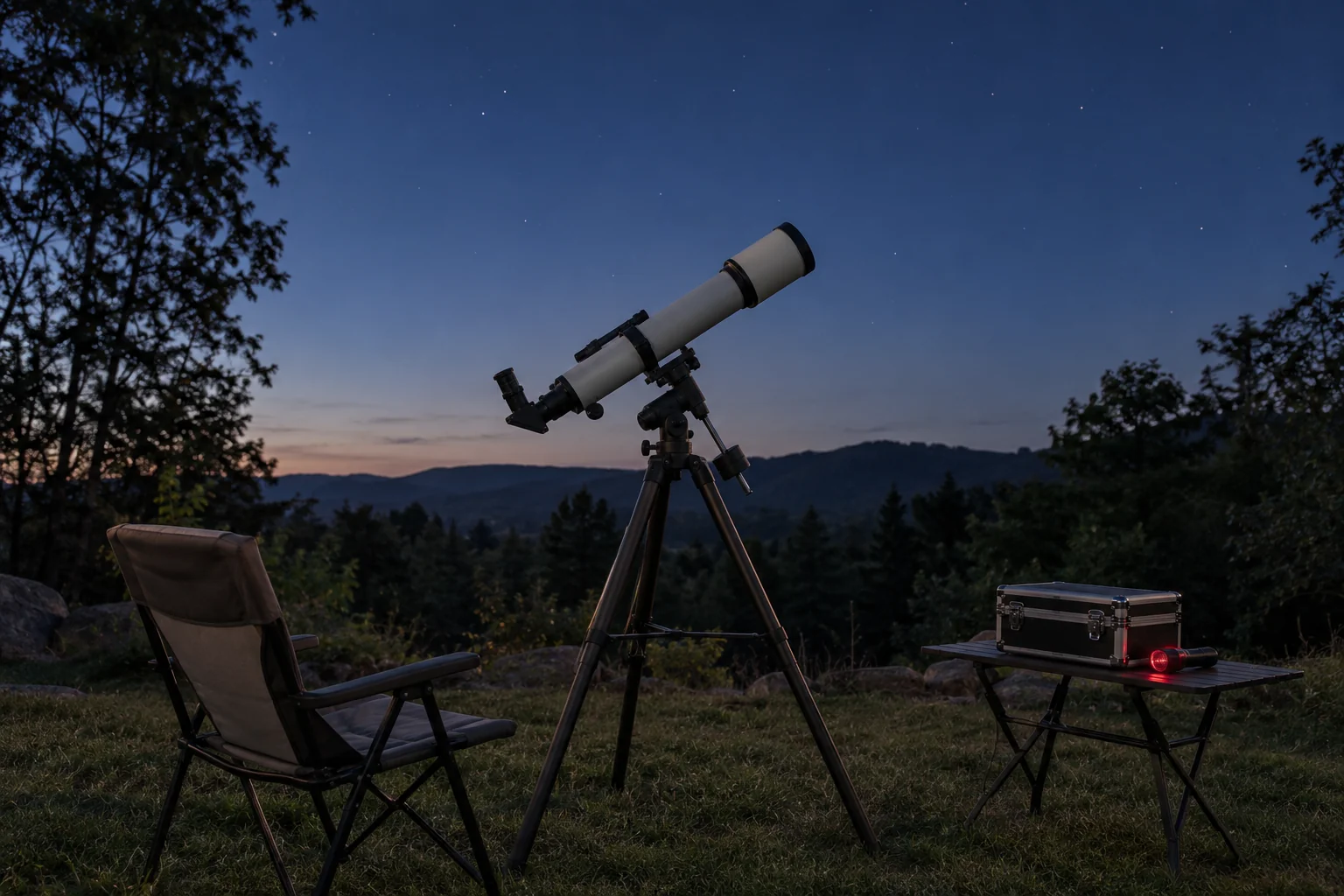
A capable telescope is only part of a useful stargazing kit. You also need a comfortable observing position, a dim light, a target guide and a way to keep the equipment organized. This list brings those pieces together for one adult observing from a backyard, driveway or vehicle-accessible site.
Choose the premium route for automatic pointing and tracking, or the value route for a substantial manual telescope. Both are built around visual observing: the Moon, planets and brighter deep-sky objects when conditions permit. A level, safe site, suitable clothing and transport are assumed. Astrophotography and solar observing are outside this kit.
THE EQUIPMENT LIST
One function. Two quality paths.
Choose one option per row, using the quantities shown. A shared choice suits both paths. Prices are US planning references checked October 6, 2026, not live quotations.
| Function and quantity | Premium | Best value |
|---|---|---|
| Telescope + mount + two eyepieces | Celestron NexStar Evolution 8 HD with StarSense — 12096$3,199.00 | Apertura AD8 8-inch Dobsonian — APT-AD8$699.95 |
| Adjustable observing chair | Starbound Adjustable Observing Chair — White$259.95 | Same shared choice$259.95 total |
| Dimmable red light | Rigel Starlite Mini — red-only variable-brightness light$24.95 | Same shared choice$24.95 total |
| Printed observing guide | Turn Left at Orion — fifth edition, spiral-bound$30.26 | Same shared choice$30.26 total |
| Front dew shield · telescope-specific | Celestron Dew Shield DX for C6 & C8$35.95 | Not required for this telescopeNo extra item |
Each telescope includes its mount and two starting eyepieces. The C6/C8 dew shield belongs only to the premium telescope. Stock is limited for the Evolution and the shared chair; confirm dispatch before committing.
Also include the small tools and consumables in the supplies checklist. A safe observing site, suitable clothing, phone, small table and transport are assumed to be available.
Why these choices?
The premium spend buys convenience as well as refinement. Both telescopes have roughly 8 inches of aperture. The Evolution adds automated alignment and tracking; the AD8 offers a simple mount and useful starting accessories at much lower cost. Neither can undo light pollution or a turbulent atmosphere.
We considered the Evolution 9.25, larger Dobsonians and the CPC Deluxe 800 HD. More aperture or a heavier dual-fork mount can benefit other observers, but the 9.25-inch system is about 62.6 lb and the CPC about 61 lb. Here, frequent setup by one beginner favors the smaller Evolution system. This is a use-based choice, not an arbitrary premium spending ceiling.
A small refractor or binoculars can be easier to carry; a camera-based smart telescope serves a different experience. We prioritize looking through an eyepiece with room to progress. Before committing, try these telescope types at a local astronomy-club session if possible. The best instrument for you must also be one you can comfortably use.
Check the space, the lift and the observing conditions.
Measure the storage and route outside. The AD8’s tube needs real car and cupboard space. Carry its tube and base separately, following the manual. Set the Evolution’s tripod height before loading it, secure the tube carefully and check clearance as it moves. Neither setup belongs on a narrow, crowded balcony or unstable surface.
Prepare before darkness. Learn the telescope controls, set the finder correctly and read the current setup instructions. The Evolution needs the StarSense calibration and alignment procedure; the AD8 needs mirror alignment checked as directed. A supplied laser is a collimation tool, not a pointer to wave across the sky.
Use this kit at night only. Never point either telescope or finder at the Sun. The AD8’s included Moon filter is not a solar filter. Start with a dry, calm forecast, a permitted observing location and a clear way back. If dew or weather defeats the setup, end the session; the basic kit is not an all-weather system.
WHAT EACH PIECE DOES
The essentials, with their trade-offs.
Celestron NexStar Evolution 8 HD with StarSense — 12096
An 8-inch EdgeHD telescope with automatic alignment, motorized pointing and tracking. It is our premium choice for an ambitious beginner who wants to spend more time observing once set up. Corrected optics and an integrated rechargeable battery make a refined, compact observing system.
The trade-offIt still needs initial calibration, a clear view of the sky and practice. Its narrow field is less suited to sweeping large star fields, and the complete telescope weighs about 42 lb. A 2018 owner report found rewarding views but also alignment and connection frustrations; it does not establish today’s software reliability.
Fit in the kitThe current package includes the mount, tripod, StarSense AutoAlign, finder, 1.25-inch diagonal, 40 mm and 13 mm eyepieces, and charging adapter. Those eyepieces give about 51× and 156×. Add the dew shield below; do not buy another starter eyepiece set or external battery automatically.
Availability / price check: Maker out of stock; Astronomics says “More on the way” at $3,199. Confirm a real dispatch date for model 12096.
Apertura AD8 8-inch Dobsonian — APT-AD8
A full-size 8-inch reflector on a simple manual base puts the budget into useful aperture and a stable platform. A two-speed focuser and generous included accessories make the AD8 a satisfying telescope to learn with, rather than a disposable first purchase.
The trade-offYou find and follow targets by gently moving the tube. The 46.13-inch tube and separate base are bulky: roughly 24.5 lb and 27.7 lb respectively. Expect to learn collimation, the adjustment that keeps its mirrors aligned. It is not a backpacking telescope.
Fit in the kitIncluded: base, 30 mm 2-inch and 9 mm 1.25-inch eyepieces, right-angle finder, laser collimator, adapter and extension tube. Start at 40× with the 30 mm; the 9 mm gives about 133×. Follow the manual for the required focuser arrangement. The cooling fan takes eight AA batteries, supplied separately.
Availability / price check: High Point lists $699.95 and in stock. Confirm the standard AD8 package, not a used telescope or an added accessory bundle.
Starbound Adjustable Observing Chair — White
An adjustable seat lets you settle at the eyepiece instead of bending over it. The padded steel-frame Starbound spans roughly 9–32 inches of seat height and folds for transport. The same purposeful chair suits both telescope paths; there is no need for a luxury duplicate.
The trade-offIt adds about 16 lb to the load, and a chair cannot correct an awkward telescope position on uneven ground. Reuse an existing stable seat if it genuinely reaches your eyepiece comfortably. The quoted white version is back ordered.
Fit in the kitUse firm, level ground, adjust while standing and check the seat is securely engaged before sitting. Confirm the current instructions and load rating for your body weight; the retailer lists approximately 300 lb. Rehearse the full height range with your telescope before your first dark session.
Availability / price check: White SBD-SB-WHITE / 329-1010-WHITE: $259.95, back ordered. Earlier indexed stock differs; current page takes precedence.
Rigel Starlite Mini — red-only variable-brightness light
A dimmable red light is more useful at the telescope than a powerful white headlamp. The Starlite Mini gives fine brightness control in a small, uncomplicated body. Keep it only as bright as needed to read the chart.
The trade-offKeep it dry; it is not a walking or emergency light. A bright red beam can still disturb other observers; aim it downward and dim it. Keep your existing white light available for safe packing and walking when needed.
Fit in the kitChoose the red-only Starlite Mini, not a similarly named white/red version. The listed package includes a 9 V battery and neck strap. Keep it dry and within reach so you are not searching for it with a phone screen.
Availability / price check: Astronomics reference $24.95. Confirm current availability and included battery when ordering.
Turn Left at Orion — fifth edition, spiral-bound
Guy Consolmagno and Dan M. Davis organize this observing guide around objects you can actually find. Eyepiece-style sketches help set more realistic expectations than processed space photographs. The spiral binding is practical beside the telescope.
The trade-offThis edition dates from 2019. Its observing method remains useful, but dated planetary tables are not a forecast for tonight. Use the publisher’s online updates or a current sky app for your date and location. Protect the paper from dew.
Fit in the kitMatch ISBN 9781108457569 for the printed fifth edition. Borrowing it is a sensible way to begin. Set aside three suitable targets before going outside; the telescope’s database is not a substitute for an observing plan.
Availability / price check: New spiral-bound reference $30.26 from the indexed Walmart listing. Direct offer and seller could not be confirmed; recheck before buying.
Celestron Dew Shield DX for C6 & C8
A light, flexible shield extends beyond the front corrector plate to slow dew formation and reduce stray light. It is a useful first accessory for the Evolution, rather than an expensive powered system bought before you know your conditions.
The trade-offA passive shield delays dew; it cannot guarantee a clear optic all night. Frequent humid observing may require a correctly matched heater, controller and power supply, which this budget does not include. Stop rather than wiping moisture from the glass.
Fit in the kitThe maker specifies C6/C8 Schmidt-Cassegrain and EdgeHD tubes with a single mounting rail. Check the opening clears the Evolution’s rail. It is not for the AD8: leave that cell empty rather than buying an incompatible shield. Keep spare eyepieces capped and dry on either path.
Availability / price check: Maker reference $35.95, listed for sale. Confirm single-rail fit.
The small supplies and things you may already own.
Allow $25 provisionally: $10 for suitable batteries or spares and $15 for a notebook, pencil and simple dry storage for charts and capped accessories. These are planning allowances, not priced branded bundles. The AD8 fan needs eight AA batteries; the premium mount has its own rechargeable battery. The red light’s initial 9 V battery is listed as included.
Bring your existing warm layers, closed footwear, phone, water, stable small table and a white light for walking or packing safely. Staying still feels colder than walking. Set phone brightness low, silence bright notifications and check your location and time in a current sky map before going out.
Keep the original protective packaging for occasional transport; the cases below are optional upgrades. Carry loose eyepieces capped, and allow damp equipment to dry before long-term storage. This allowance does not buy winter clothing, remote-site safety equipment, a vehicle or a complete heated dew-control system.
Your first observing session: three targets are enough.
Plan a short session. Pick the Moon when visible, one accessible planet and a bright star cluster suited to your date and location. Use current sky information, not a fixed list of planets supposedly visible every night. Allow your eyes and equipment time to adjust, away from direct lights.
Start with the widest supplied view. Use the Evolution’s 40 mm or AD8’s 30 mm eyepiece to find and center the target. Focus carefully. Increase magnification only when the image remains useful; a larger blurry disc is not an improvement. With the manual Dobsonian, practice gentle nudges to keep the target in view.
Look patiently. Lunar shadows and planetary detail vary with illumination and atmospheric steadiness. Many faint objects appear as subtle grey shapes rather than the colored images seen online. Sketching a few details often makes the session more rewarding than racing through dozens of database entries.
Finish with a repeatable routine. Note the date, location, eyepiece and conditions. Account for each cap and accessory, switch off the equipment and recharge the premium mount before the next outing. Do not rub dew or dust off optical surfaces; follow the maker’s cleaning guidance when cleaning is actually needed.
PLAN THE SPEND
What does a complete beginner stargazing kit cost?
Premium path
$3,575.11starter planning estimate · dated US references
- Telescope, mount and included starting eyepieces
- Adjustable chair, red light and observing guide
- $25 provisional batteries and small-supplies allowance
Best value path
$1,040.11starter planning estimate · dated US references
- Telescope, mount and included starting eyepieces
- Adjustable chair, red light and observing guide
- $25 provisional batteries and small-supplies allowance
| Cost | Premium | Best value |
|---|---|---|
| Telescope + mount + two eyepieces | $3,199.00 | $699.95 |
| Adjustable observing chair | $259.95 | $259.95 |
| Dimmable red light | $24.95 | $24.95 |
| Printed observing guide | $30.26 | $30.26 |
| Front dew shield · telescope-specific | $35.95 | — |
| Batteries or spares · estimate | $10.00 | $10.00 |
| Notebook, pencil and dry accessory storage · estimate | $15.00 | $15.00 |
| Starter planning total | $3,575.11 | $1,040.11 |
| Optional: One medium-power eyepiece | $438.00 | $70.00 |
| Optional: Telescope transport case | $469.95 | $89.95 |
| With both optional additions | $4,483.06 | $1,200.06 |
The $25 allowance is provisional, not a verified product bundle. Equipment alone totals $3,550.11 or $1,015.11. Tax, shipping, import charges, clothing, transport and a powered dew-control system are excluded. The book reference needs direct offer confirmation.
Already equipped? Reuse a suitable observing seat to remove $259.95, or borrow the book to remove $30.26. Keep the correct seat height and stability rather than saving money with an unsuitable chair. Retain the included eyepieces before deciding on upgrades.
No extra shield on the AD8: the dash means the selected C6/C8 shield is not applicable, not that all dew problems disappear. Both setups may need additional protection in persistently damp conditions.
The expanded totals include one optional eyepiece and the matching case. The Evolution’s tripod and the AD8’s base still travel separately. These totals are planning comparisons, not in-stock shopping carts or live quotations.
Upgrade the observing experience after a few nights.
The optional eyepieces fill a useful medium-power role with more comfortable eye relief. The two focal lengths differ intentionally: the telescopes have different focal lengths, so 17.3 mm on the Evolution and 12 mm on the AD8 give roughly comparable observing magnifications. Buy one suited to your telescope, not both automatically.
A transport case becomes more valuable when you travel often. The premium case holds the Evolution tube and mount, with its tripod separate; the AD8 bag holds only the tube, with the base separate. Neither is a complete travel solution by itself. Check the loaded weight before deciding that a case solves the carrying problem.
Leave large eyepiece collections, imaging cameras, motorized focusers and specialist filters for a specific need. Persistent dew may justify a properly matched powered system later. If a dark-sky evening is part of an overnight trip, the Car Camping Kit covers the separate sleeping and campsite equipment.
Tele Vue Delos 17.3 mm — EDL-173
A 72-degree apparent field and 20 mm eye relief offer a spacious view without requiring the eye to press close to the lens. The adjustable eyeguard helps position your eye. On the Evolution, this gives a useful middle step of about 117× between its supplied eyepieces.
The trade-offIt is a substantial cost for one focal length, and eye placement still matters. More field or price does not overcome poor atmospheric conditions. Try the included eyepieces first; this is a comfort and viewing-window upgrade, not an essential purchase.
Fit in the kitIts 1.25-inch barrel fits the Evolution’s supplied diagonal. Secure the eyepiece and check balance and clearance before moving the telescope. On the AD8 it would give about 69×, so swapping paths changes the result.
Availability / price check: Exact 17.3 mm EDL-173 listed $438, in stock at research time; recheck before ordering.
Agena Starguider Dual ED 12 mm
At about 100× in the AD8, this offers a useful intermediate view with more forgiving eye relief than a short Plössl. Its 60-degree apparent field and adjustable eyecup make it a sensible step up without buying a whole case of focal lengths.
The trade-offThe maker lists the 12 mm as out of stock with an estimated mid-October arrival. Jay’s 2016 first-hand report found it capable in a refractor and a larger Dobsonian, but that is older evidence on different telescopes, not a test of current production.
Fit in the kitUse the AD8’s included 1.25-inch adapter and check the eyecup position for your eye or glasses. In the Evolution it would give about 169×, not 100×. The supplied AD8 eyepieces remain usable while you decide whether this addition is worth waiting for.
Availability / price check: E-AG-SGED12: $70, out of stock; mid-October ETA is an estimate, not a delivery promise.
Celestron Optical Tube Carrying Case — 94004
Thick padding, a shaped shell and wheels make this a practical upgrade when the Evolution travels regularly. Celestron explicitly lists the Evolution 8/8HD with its mount as compatible. The adjustable padding and retention strap let you secure the actual load.
The trade-offThe empty case weighs about 18 lb and measures roughly 33 × 17 × 16 inches outside. It is large, and wheels help mainly on suitable smooth surfaces. It is not a waterproof container or a promise that your loaded case is airline-safe.
Fit in the kitThis is the larger 94004, not the smaller 94003. The tripod travels separately. Arrange the foam and removable accessories according to the instructions; do not force the lid onto StarSense or finder fittings. Check the loaded lift and vehicle space first.
Availability / price check: Maker $469.95, in stock. Confirm the 94004 case and the packing arrangement for your fitted accessories.
Apertura 8-inch Dobsonian Soft Case — DOBCASE8
A padded, purpose-sized bag protects the long AD8 tube from everyday scuffs and makes it easier to carry between house and vehicle. The retailer explicitly lists the AD8 as compatible. This is more useful than trying to force the tube into a generic small equipment case.
The trade-offIt protects the optical tube only: the Dobsonian base still travels separately. The soft bag is not waterproof or crush-proof, and it does not make a heavy tube light. Secure the telescope inside the vehicle rather than leaving it loose.
Fit in the kitChoose APT-DOBCASE8 for the 8-inch tube. Check how protruding fittings sit in the bag and remove vulnerable accessories when needed. Let damp equipment dry indoors before closing it into storage; retain the original shipping protection for major moves.
Availability / price check: High Point $89.95, in stock. Base, accessory case and telescope excluded.
A few decisions, made simpler.
Do I need a telescope to start stargazing? No. Begin with your eyes, a sky map or binoculars you already own. This kit is for someone ready to invest in a substantial visual telescope, not the minimum cost of enjoying the sky.
Will the premium telescope show more than the value one? Not automatically. Their similar aperture means the premium difference is largely in optics, operation and convenience. Conditions, setup and experience strongly affect what you see.
Can I use the telescope immediately without buying extra eyepieces? Yes, after proper assembly and alignment. Each selected telescope includes two useful starting eyepieces. The optional upgrade is for a particular viewing experience, not a missing essential.
Can I mix the two quality paths? Yes for the chair, light and guide. Eyepiece barrel fit and resulting magnification still need checking. The dew shield and cases are telescope-specific; do not swap them blindly.
Can I observe through a window? An open outdoor position is preferable. Window glass and temperature differences can spoil the image. Choose a safe clear area rather than putting a heavy telescope at a window edge.
Is a new telescope model always better? No. A current, well-supported optical design can remain an excellent choice for years. We check the products sold now, their exact packages and evidence dates; we do not relabel an old test as a new comparison.
Research, sources and what to recheck.
Researched for the US market on October 6, 2026. Product cards link to maker documentation, current listings and identified first-hand reports. We have not physically tested this kit. The 2018 Evolution owner report and 2016 eyepiece report describe earlier use; neither verifies current firmware, manufacturing or every competing product.
The AD8 has identifiable hands-on coverage from AstroBackyard, a commercial site with affiliate links. Smaller accessories are selected mainly on dimensions, construction and fit. Exact current comparative evidence is limited for the premium eyepiece and some accessories. These are reasoned recommendations for this use, not a claim that every alternative was tested.
USD prices are dated planning references before tax, delivery or import charges. The Evolution and chair have availability constraints; the value eyepiece has an estimated restock date. The book price comes from an indexed offer and needs direct confirmation. Recheck stock, model, package, safe lifting and fit before ordering. Independent specialist review has not been completed. No affiliate links are active.